


What You’ll Take Away
The Limits of Human VAs: Why even great VAs face structural constraints with speed, volume, accuracy, and turnover.
AI as Your Always-On Partner: How AI assistants deliver instant replies, automate proposals, and keep follow-ups consistent 24/7.
Evaluating Today’s AI Options: What to know about leading platforms—and how their capabilities differ.
The Power of a Hybrid Model: Why combining AI with VAs creates a faster, more stable, and more scalable sales workflow.
A More Resilient 2026 System: How reducing dependence on human-only processes protects conversions and supports higher inquiry volume.
Evaluate the results: Measure what a VA and an AI assistant can achieve.
Let us know what you think, and grab a seat for our upcoming “How to Make AI Sound and Act Human” webinar.
Why This Matters for Venues & Event Pros
Today’s couples and clients expect swift replies, near-instant availability checks, and accurate pricing—often outside conventional business hours. In that environment, the speed and consistency of your responses can make or break a booking.
Research on “lead response time” shows that businesses contacting prospects within five minutes makes a business 21× more likely to to have meaningful conversations and qualify a lead versus those waiting longer.
A common benchmark is that the first responder wins: 7 in 10 couples say the number one thing they look for when booking vendors is how responsive they are.
According to CVENT, 50 % of event pros in 2025 report using AI tools in planning or operations.
If your business replies slowly, you risk losing leads, even if your space, pricing, and packages are excellent. That’s where relying solely on human or VA-based response workflows becomes a structural liability.
(Estimated read time: 7 min | 1,530 words)
1 | Human VAs: Valuable, but Structurally Limited
Virtual assistants play a meaningful role across event operations, from responding to inquiries, booking tours, and preparing proposals, to coordinating vendors, managing payments, and more. Their human judgment, flexibility, and empathy are important strengths.
But when it comes to high-volume or time-sensitive tasks, like first inquiry responses, availability checks, automated proposals, consistent follow-ups, human VAs face structural constraints:
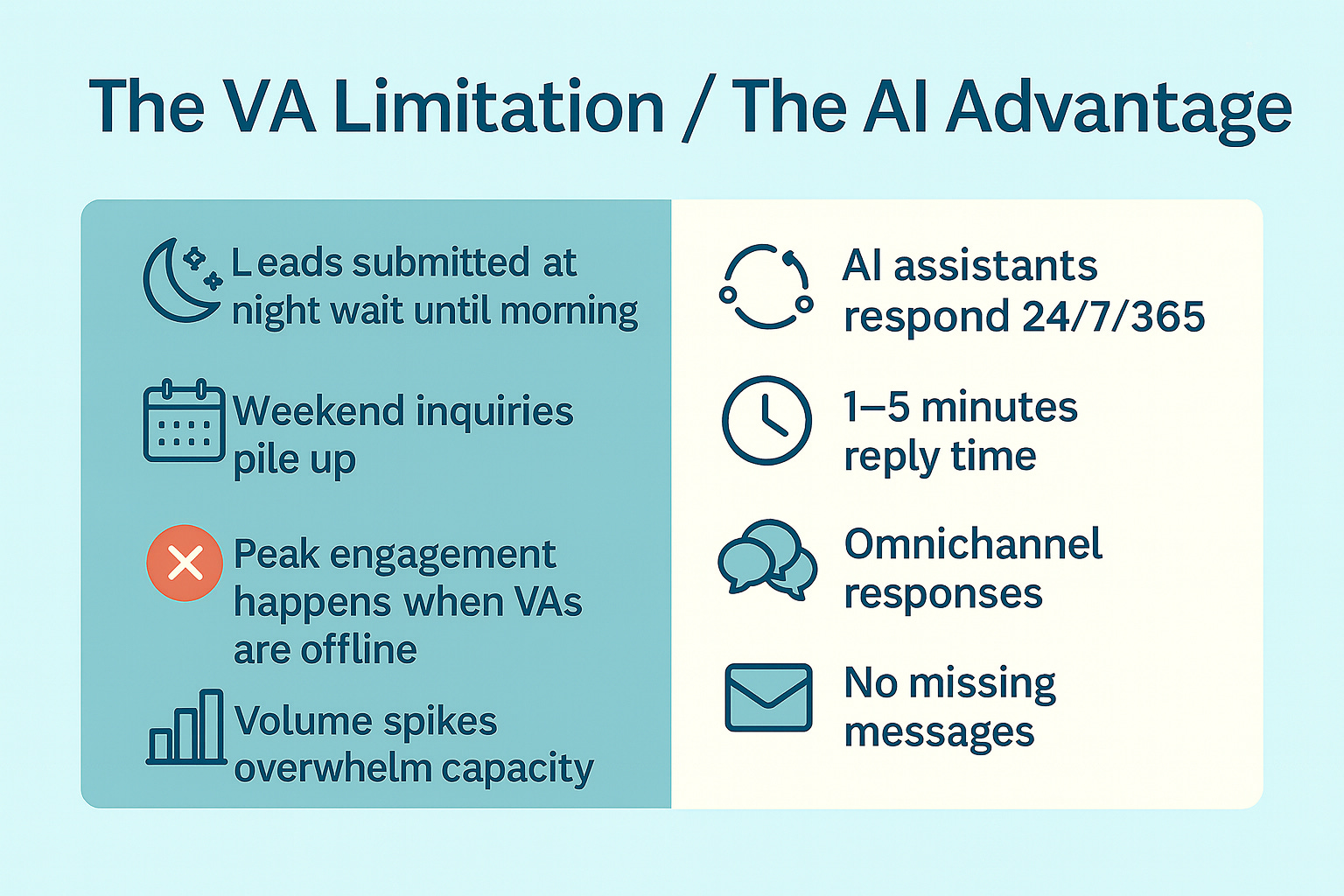
Humans need rest, breaks, and personal time; they don’t work 24/7, nor they work at nights or weekends.
Workload surges (e.g., after ad campaigns or during high-season inquiries) overwhelm capacity.
Performance varies due to fatigue, illness, distractions, or personal factors.
Employees may leave, triggering costly cycles of recruitment, training, and ramp-up.
In short: relying heavily on human VAs for time-critical workflows introduces variability, latency, and risk, exactly the vulnerabilities modern buyers punish. ⚠️
2 | Why AI Assistants Are a Strategic Move
In contrast, AI assistants offer a consistent, scalable backbone for the parts of the process where speed, availability, and accuracy matter most.
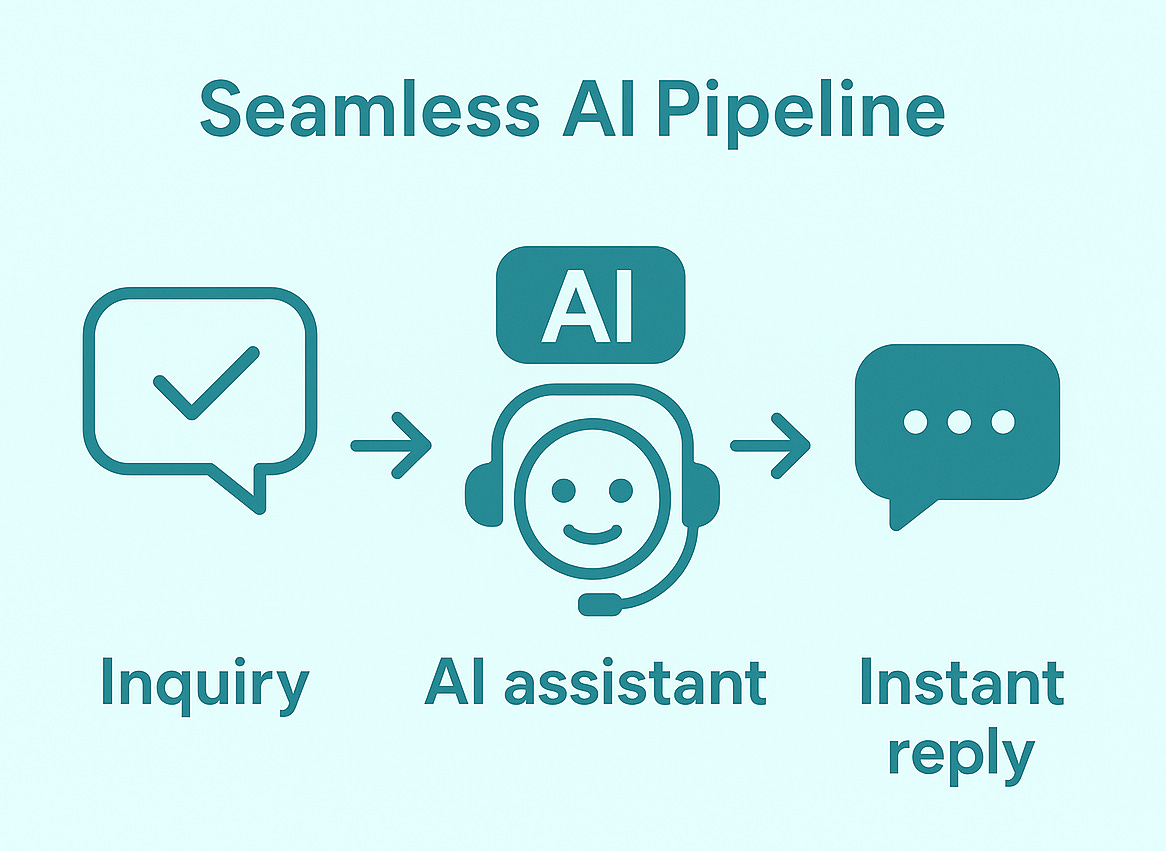
AI tools enable instant responses and follow-ups, even outside business hours, ensuring no lead ever waits.
They automate availability checks, proposal generation, and tour booking, tasks that would otherwise require manual and time-consuming data lookups.
The broader event industry is embracing AI: recent surveys show that roughly 50% of event professionals now leverage AI tools in their operations.
That doesn’t mean human VAs become completely obsolete. Rather, AI handles the routine, high-volume backbone of your lead flow—freeing VAs, your team or even yourself to focus on high-touch, human-driven tasks like vendor coordination, complex negotiations, closing and event logistics. 🏆
3 | Today’s Solutions: AI Assistants in the Market
As AI adoption accelerates in the event and venue sector, several platforms have emerged to help venues, vendors, and event pros, particularly in the areas that matter most for operational reliability: omnichannel coverage, proposal accuracy, availability checks, and integration depth.
Breezit AI
Breezit AI positions itself as an AI sales assistant (available 24/7) designed specifically for venues and event vendors. The platform reports that users have achieved up to 50% increases in bookings and 20+ hours saved per week, driven largely by its ability to maintain sub-five-minute response times across channels (their AI replies to phone inquiries are immediate, and emails or texts go out within 1–5 minutes, averaging about 2.5 minutes).
Breezit also offers features such as: smart follow-ups, live calendar syncing, includes an option to produce branded, 100% accurate and tailored proposals, easy integrations with existing CRMs, and a streamlined contract-to-payment process.
The main limitation today is that it does not yet include a dedicated mobile app.
VenueX AI
VenueX AI focuses on personalized replies and after-hours coverage, targeting venues that struggle to maintain responsiveness during weekends or peak engagement hours. It supports email, SMS, and website chat, and offers review-request campaigns.
However, the platform does not disclose reply-time benchmarks or quantified booking-lift metrics, making performance difficult to evaluate objectively. While it provides engagement tools, critical sales-enablement features such as phone coverage, proposal accuracy, contract workflows, and CRM integration remain missing at the moment.
For venues looking primarily for lead nurturing rather than full-funnel automation, VenueX AI can add value, but it will not replace the need for VA or team intervention in the sales process.
VenueAI
VenueAI positions itself as a lead conversion assistant aimed at increasing qualified tour bookings. The company highlights potential boosts of up to 50%, while citing more conservative results of 10–20% among active customers. Its average response times fall between four and five minutes.
The platform handles email and text inquiries, smart follow-ups, CRM integrations,uses venue-specific tone, and manages tour scheduling via calendar sync. Yet, VenueAI does not extend into contract or payment workflows, and their proposal generation lacks clarity—their website does not detail how proposals are created. It also does not support phone coverage yet.
For teams seeking AI support strictly at the inquiry and scheduling stages, VenueAI could be a fit; for those seeking to automate the full inquiry-to-booking pipeline, additional tools or VA support might be required.
The takeaway? You should choose an AI assistant that deeply integrates into your sales operations by reducing human dependency at the most time-sensitive stages. 🚨
4 | What Happens When You Combine AI + VAs
When venues adopt a hybrid model where AI and VAs work together, the results are:
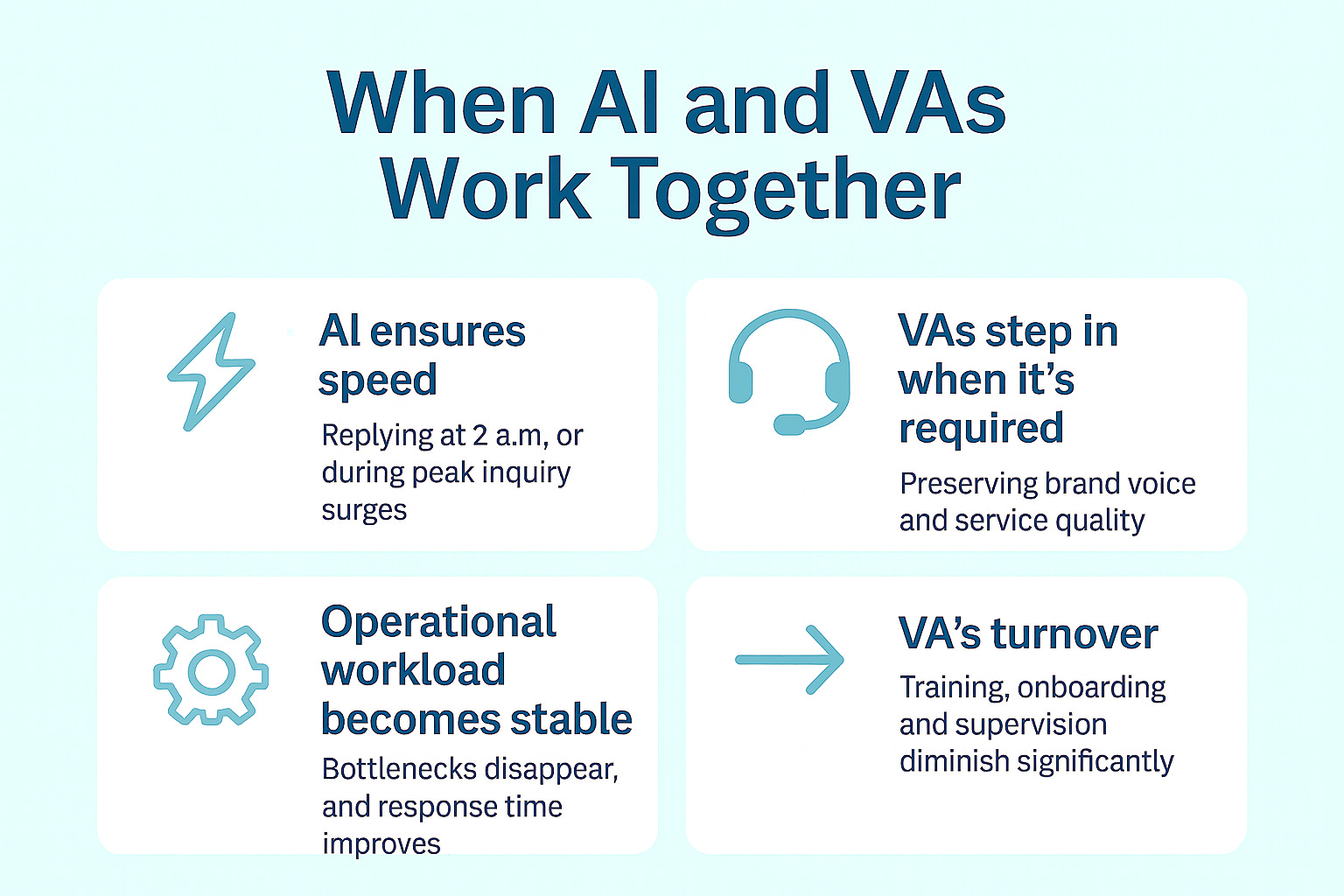
AI ensures consistent first-touch speed (even at 2 a.m. or during peak inquiry surges.)
VAs step in for follow-ups that require discretion, empathy, or human judgment, preserving service quality.
The entire operational workload becomes more stable; bottlenecks disappear, and response time becomes a non-issue.
The risk, cost, and friction associated with VA turnover—training, onboarding, oversight—diminish significantly.
And speed matters: responding to leads under 5 minutes increases conversion rates, yet many companies take hours or even days to reply. Faster responses also mean you’re far more likely to win the booking, with studies showing that 78 % of sales go to the first responder and that reaching leads within minutes rather than hours dramatically boosts engagement and revenue potential.
In effect: you upgrade your operational backbone, while preserving the human-level service that sets your brand apart. 🤝
5 | What This Means for Venue & Event Teams in 2026
If your lead-response system depends heavily on human or VA labor, you’re carrying a hidden operational liability: variability, risk, and inefficiency.
AI assistants aren’t a substitute for human judgment—but they solve the structural problems humans can’t solve, like unpredictability, downtime, and scale limitations.
Combining AI for speed and scale, and humans for touch and strategy, becomes the most resilient, efficient, and future-proof operational structure.
For busy venues, high-volume months, or growth phases, AI doesn’t just support the team: it becomes the foundation that sustains higher lead flow without breaking the staff or quality standards.
6 | Next Step: Start Working with AI
If you’re ready to modernize your lead handling workflow and/or give your team the room to focus on what they do best, schedule a short audit to evaluate:
Your average first-response time (over the past 3–6 months)
Typical lead volume peaks (seasonal surges, weekends, campaigns)
The time your VAs spend on first-touch inquiries vs. high-value tasks
The number of leads that go cold before a human ever responds
🧠 From there, consider piloting an AI assistant to handle the lead response and other steps from your workload. Compare conversion rates, speed, and workload shifts. The improvement in consistency will likely speak for itself.
7 | Join the Conversation
Have thoughts on how your venue or vendor business could integrate AI into your existing VA workflow? Drop your questions or scenarios in the comments.
🚀 Want to learn how to make AI sound authentically human?
Join our upcoming webinar:
“How to Make AI Sound and Act Human When Communicating With Your Leads.”
Click here to sign up and get an early heads-up when the webinar goes live.
Until next time—keep your systems sharp, your workload manageable, and your bookings strong. 🥂
— FutureBooked